Making A Family Home
February 25, 2010
I have fond memories of my childhood home. I grew up as an only child and we lived very simply. While my mom (who is still my best friend) and I played at the beach and shopped at the mall together, we spent a lot of time at home. I remember playing Barbies and reading stories. I remember our family dinners and weekend get togethers with extended family.
It’s 2010 and I have my own family now. It’s a different time. In a world of technology and high-speed living, many families (including us) our looking for ways to slow down and smell the virtual flowers. We spend a good amount of our time at home, but we still manage to get out and about on a regular basis. And I’m still trying to find that balance.
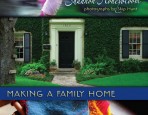
Making A Family Home, by Shannon Honeybloom, “combines the mindfulness of modern homemakers with an understanding of childhood development, and an attention to truths such as love, goodness and beauty [to create] a beautiful and nuturing home.” The author beautifully and artistically depicts the home as a safe, happy, healthy environment where children develop and thrive. Step-by-step, room-by-room, the author shows us how to create a “family home.” The book is very personal as the author pulls from her own home and family life experience.
The book is beautifully illustrated with incredible photographs from the author’s home. She writes the book from the perspective that a child’s personal develpment begins in the home. I love her simplistic approach to what a child “needs” to develop. I gained a new perspective on our home and how I can transform it into more than just a place where we eat and sleep. I’ll leave you with a quote from the author that I absolutely cherish and have started to take to heart…
In the end, it’s not about enrichment classes, educational videos, multiple after-school activities. It’s not about spending a lot of money or buying a lot of things. It’s about creating a calm, beautiful and healthy home for our families. Such a home is the foundation for happiness and success in the world.
Making A Family Home retails for $20 and is available on the site.
I did not receive compensation for this post. A copy of the book was received to facilitate this review.
The Hassle-Free Walt Disney World Vacation
March 22, 2009
My husband and I traveled extensively before we had my son. We immersed ourselves in the Scottish culture and hope one day to bring our son back to the place where we were living when we found out were were pregnant. Our travels have been understandably limited because traveling with an infant and now a toddler is not easy. But one day in the not-so-distant future we are going to plan a trip to Florida to experience Walt Disney World. You may have gathered from reading my blog that I LOVE all things Disney. I had a wonderful opportunity to attend both the Halloween and Holiday Mom blogger events to get an inside look on what Disney is doing to make things spectacular. My son and I are at Disneyland every week thanks to the season pass we purchased and we’d be at Walt Disney World in a heartbeat if it weren’t for that 5 hour flight!
When my husband and I travel, we spend a lot of time researching the destination. I have been BEGGING my husband for a family trip to Walt Disney World and recently had the opportunity to review The Hassle-Free Walt Disney World Vacation (the 2009 edition at that!) by Steven M. Barett. This book was published by The Intrepid Traveler, “a privately-owned independent travel publishing company dedicated to helping people make travel a more integral part of their lives.” I was excited about going to Walt Disney World BEFORE I read this book and now I’m ready to book the trip! People have told me how crazy taking a child to Walt Disney World…how expensive it is….how crowded and hot and miserable it can get in Florida. My advice to all of you who have been given this exact information is to read this book. The author has over two decades of experience navigating the Walt Disney World Resort. I honestly think his first chapter on planning is the most essential starting point, particularly for someone like me who has never been to that side of the country or done any research on the resort. He gives you tips on when the best time to visit the resort is, where to stay, how to get there, what to bring, what to eat, touring tips, and how to buy tickets (I didn’t even know that I needed tips on how to buy tickets). If you only read one chapter of this book (which I guarantee that won’t be the case once you start reading it), then read this one. The author knows Walt Disney World inside and out. His tips and insights are practical and feasible. If you are traveling to the resort with young children, teens, or seniors, be sure to spend some time going through his suggested one and two-day touring plans for each specific park in the resort. I really appreciate his tips on rides with the shortest wait times (essential for tots with a short-attention span), attractions that may frighten my toddler, resting places, and the least crowded restrooms. Steven Barrett rates each attraction and gives you his opinion and tips on each one. The guide includes maps and pictures and is thoroughly detailed and inclusive.

The Hassle-Free Walt Disney World Vacation is available for purchase on the site and retails for $15.95. If you’re interested in finding out more information about The Intrepid Traveler’s money-saving, how-to, and guidebooks visit their site.
We seek to accomplish this goal by publishing money-saving, horizon-expanding travel how-to and guidebooks and by operating this web site.”
Profuse thanks to The Intrepid Traveler and Mom Fuse for this review opportunity.
Journal Buddies
February 4, 2009
I remember writing in a journal as a little girl. I still have that journal… It’s so funny to go back and read what I thought was so important at the time…my hopes…my dreams…my struggles…my fears… Journaling, regardless of age, is a wonderful way to express thoughts, feelings, and ideas. There is a fabulous, gender-specific journal for children called Journal Buddies. The author and creator, Jill Schoenberg, takes journaling to a whole new level with an aim at improving a child’s self-esteem.
We received A Boy’s Journal for Discovering and Sharing Excellence to review. Unlike a traditional journal, reserved for one’s own private thoughts and words, the content of Journal Buddies is meant to be shared. In other words, your child AND his buddy (which could be a friend, parent, sibling, pet, or even an imaginary friend) complete each entry (the buddies can differ from day to day). There are thirty entries which span about a month. Not only will this journal build your child’s self-esteem, it will foster his creativity. Your child can express himself through writing, painting, drawing, stamping, stickers, photos, or anthing else he likes to do. Lastly, the book focuses on giving, sharing, and receiving kindness. I think this is especially important for boys, particuarly in a society that emphasizes the rough and tough aspect of the male species. Can you imagine the type of society we’d have if very young boys grew up with an understanding of the importance of kindness?
Each journal entry consists of a thought for the day (i.e. advice, reminders, etc.), qualities/traits/talents (this is where a buddy comes in), a focus word for the day (i.e. an idea to explore or a word to think about), and blank pages that can be used for words, art, drawings, and/or poetry. At the end of the journal, the author leaves a place for reflection. I think this is the most important part of the journal. This is where a child will realize self-discovery. I can imagine my son looking at this journal years after it’s been “written.”
Journal Buddies was a winner of the 2008 Mom’s Choice Awards which is an award representing quality and ingenuity. This award alerts the consumer as to the appropriateness of a product for children. For more information, including excerpts from the Journal Buddies, check out their website. Both the girls and boys’ version of the journal retail for $16.95 and can be purchased directly on the site.
Profuse thanks to Journal Buddies and the Family Review Network for this wonderfullly informative review opportunity.
The No-Cry Nap Solution
February 2, 2009
I don’t remember when I realized my son had difficulties getting to sleep. In fact, I thought it was perfectly normal for my newborn baby to want to sleep on my husband or myself. That newborn became an infant who co-slept with us for over 15 months. It was so much easier to have him sleep with us because I was still nursing him in the middle of the night. Once I stopped nursing, I realized that my husband and I were not sleeping well because my son was still in our bed. It took us many, many months to get my son out of our bed and into his crib because I refused to let him “cry it out.” But sleeping in the crib at night did not translate to sleeping in the crib for naps. In fact, the only way I could get my son to nap was if my husband or I layed next to him on our bed. Well, you can imagine how limiting that was for me with all of the dishes and laundry and cooking I need to do (no sarcasm there…promise!).
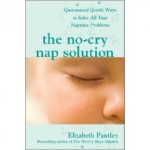
I recently had the opportunity to read and review Elizabeth Pantley’s “The No-Cry Nap Solution.” I have been implementing the strategies in this book for at least a month and a half, if not longer. It has been less than two weeks since my son started consistently sleeping in his crib for naps. His naps aren’t perfect…yet. He lies there in his crib, babbling away, trying to get our attention. However, he’s not crying and he’s not taking cat-naps, so for us, this has been a huge step in the right direction. Several days last week, he took 2 hour naps for the first time. Part of the problem I was having was inconsistency about how, where, and when my son was napping. Some days my husband or my mom would watch him, throwing the entire sleep schedule off. This quote from the book was one of the things that freed my husband and I from rules and stereotypes: “There are no absolute rules that you must follow when it comes to where or how your child naps.”
It wasn’t until this book that I realized how important naps are. It’s pretty obvious that naps are important, particularly when my lovable, funny, smiling son, turns into a whiny, cranky toddler. But this book will give you the scientific and biologic reasons to help you understand how your child benefits from naps, how much time your child needs to nap, and why the timing of the nap is so important. For me, it was important to journal my son’s nap and sleep patterns for a few days. What I realized was that some of the problems we were having were my fault. For example, the days when I needed to run errands and let him sleep in the car, were the days he was the most fussy. I believed that those catnaps were enough to get him through the day but the book taught me otherwise. Elizabeth Pantley has devoted an entire chapter to creating a sleep log and a nap plan for your child, and I highly recommend that everyone who is having difficulties with naps, do this as a starting point.
I wish I had this book before my son was born. There is an entire section devoted to naps and newborn babies. If I would have read it ahead of time, I would have avoided a lot of the problems we faced. Fortunately, the remainder of her book is devoted to solving those specific naptime problems. The two chapters that I found to be the most beneficial for our situation were those on catnaps and resistance to naps. For example, my son would always wake up before his naptime SHOULD be over (he is only taking one long nap a day). I knew he was still sleepy because he would wake up crying and fussy. The book suggested that I go into his room five to ten minutes before I anticipated he would wake up (hence the benefit of the sleep log I talked about above) and help him go back to sleep. This was just one of the many suggestions outlined in the book.
Getting my son to nap was actually more difficult than getting him to sleep through the night. After reading this book, I realize that things could have been different. If you’re in the midst of a naptime battle, I highly suggest you read The No-Cry Nap Solution. It’s available on Amazon.com for $10.85 with free shipping!
Profuse thanks to Elizabeth Pantley and the Family Review Network for this wonderfullly informative review opportunity.
Green Goes With Everything
December 17, 2008
Up until a couple of years ago, I had never heard of phthalates, BPA, or parabens much less their impact on the health of my family. I have always tried to be as natural as possible by eating healthy and avoiding unnecessary chemicals. When I got pregnant with my son two years ago, I ended up on bedrest at 17 weeks which gave me too much time and not enough to do. Most of my days were spent on the phone and online researching trendy strollers and safe car seats. It was during that time I happened upon a blog post (I didn’t even know what a blog was) warning about the dangers of BPA. And that is where my green adventure began.
It’s been two years and “going green” has never been easier. I recently read Green Goes With Everything by NBC’s Today Show contributor and KNTV’s Green Editor Sloan Barnett. I’ve done a ton of research on the subject but I still found this book to be informative and practical. When people think of “going green” they envision giving up lots of the green stuff to achieve this. Sloan Barnett’s book gives you the 411 on everything from contaminants in bottled water (yikes!) to saving money by reducing your energy usage. Each chapter begins with The Plain Green Truth, a series of “green” facts that challenge what you think you know, and ends with Five Green-Hot Tips to get you started on your green path to a healthier life.
Green Goes With Everything provides credible information on the toxins we come in contact with everyday and how they have the potential to impact our health. Her solutions and alternatives to conventional products are a great start, particularly if you have just started thinking about “going green.” I have to admit that while much of the information was not new to me, I was able to find some recommendations on products that I had never heard of (her resource guide at the end of the book is amazing). Her last chapter on Clean Energy is particularly useful to my husband and I at this time in our lives, having just moved into a home of our own. I highly recommend this book for anyone who has limited knowledge on going green or would like a little refresher on the subject.
You can purchase Green Goes With Everything on Amazon.com. Be sure to take the Body Burden Tour to find out which household products are burdening your body and visit Sloan Barnett’s blog for new green product finds and offers and insights into green and health issues concerning the world today.
Here is a list of 10 steps from the site that you can work on right now to achieve a greener, healthier home:
1. Start by replacing a bunch of your cleaners (your general spray cleaner, glass cleaner, counter top cleaner, floor and bathroom cleaners) with a natural, nontoxic all-purpose cleaner. You will only need one to do that. Really!
2. Replace your laundry detergent with a natural nontoxic one so the clothes you wear and the sheets you sleep on have no fumes for you to breathe.3. Go to your bathroom and read the shampoo, makeup and moisturizer labels. Ask yourself, “Do I really need scent in these products?” Take stock of all of your other products and try to replace one a week with a safer, greener choice.
4. Use BPA-free plastic baby bottles and fill them with breast milk or organic formula. Choose powdered formula over canned formula to avoid BPA leaching from the can-lining.
5. Pay attention (without freaking out) to the toys you buy for your kids. Avoid lead paint and soft plastics that contain phthalates.
6. Shop the perimeter of the grocery store and avoid processed food. Even better, choose organic and locally grown meats, dairy, fruits, and vegetables.
7. Try to get the plastic containers out of your kitchen and replace them with glass containers.
8. Make a vow to stop buying bottled water—NOW. Instead, buy a water filter pitcher and keep two in your fridge at all times.
9. For cleaner and healthier air, open your windows once a day when the outside temperature is comfortable.
10. When buying new stuff for your home, focus on green products especially mattresses and carpets.
Book Review: Sweet Life
October 16, 2008
I finally sat down this week and read a book. It’s unbelievable really. Mia King, the national bestselling author of Good Things, has just released her newest book called Sweet Life. Without spoiling it for you (you absolutely must read this book!) the book chronicles one woman’s “search for a sweeter life.” Who wouldn’t jump at the opportunity to leave the fast-pasted, busyness of New York for island paradise? When the Price’s make the move to Hawaii for a job transfer, it’s all but paradise for Marissa. Going from director of a consulting firm in New York to housewife and stay-at-home mother is anything but bliss for Marissa.
What ensues is a journey to re-connect with her daughter (who been raised by a nanny for much of her life) and save her marriage from complete failure. Along the way she meets three women who help her redefine the meaning of ohana or family.
Mia King has a way of drawing the reader in, as he/she is right there amidst the island sunsets and beaches. Mia richly develops each character, making you feel as if you know them. There were times when I would start to tear up because I had become emotionally involved. That is the sign of a great book! With her intricate knowledge of the island, Mia has a way of subtly infusing island culture into the the story.
Sweet Life is available on Amazon.
Profuse thanks to Mia King and the Family Review Network for this review opportunity.